Travel patterns across the country show sustained demand for immersive landscapes, open-road flexibility, and nature-centered itineraries, making National Parks and Scenic Road Trips USA a dominant theme in domestic exploration. The convergence of conservation awareness, remote-work mobility, and infrastructure access has shifted tourism away from dense urban clusters toward distributed, experience-rich corridors defined by geology, biodiversity, and historic transportation routes.

The Structural Appeal of Protected Landscapes
The United States maintains one of the most extensive protected land systems in the world. The framework administered by the National Park Service includes national parks, monuments, seashores, recreation areas, and scenic trails, forming an interconnected matrix rather than isolated destinations. This structure enables long-distance travel that remains continuously anchored in preserved environments.
Unlike single-site tourism models, national park travel encourages geographic sequencing. Visitors move through multiple ecological zones within a single trip, observing how desert, alpine, forest, and coastal systems interact across regional gradients. A traveler moving from Nevada’s arid basins into the granite elevations of Yosemite National Park experiences measurable transitions in temperature, vegetation density, and hydrology within a day’s drive.
This layered exposure creates educational value alongside recreation. Geological time becomes visible through canyon stratification, glacial polish, and volcanic formations such as those documented at Crater Lake National Park, where the caldera illustrates collapse following Mount Mazama’s eruption. Scenic road trips convert these scientific narratives into lived spatial understanding rather than abstract interpretation.
Infrastructure Designed for Movement
Scenic travel in the National Parks and Scenic Road Trips USA relies on a transportation philosophy that integrates engineering with landscape preservation. Roads are constructed not only for access but for visual continuity, elevation reveal, and controlled pacing.
The Blue Ridge Parkway demonstrates this principle through curvature, grade management, and limited commercial intrusion. Designed as a linear park, it avoids visual noise while guiding travelers across Appalachian ridgelines. The absence of freight traffic allows uninterrupted engagement with mountain ecosystems, creating a rhythm distinct from interstate travel.
Similarly, Utah’s Zion-Mount Carmel Highway tunnels directly through sandstone formations, intentionally framing geological scale as part of the transit experience. The road itself becomes interpretive infrastructure rather than a neutral conduit.
Historic corridors such as Route 66 add cultural stratification to scenic mobility. Motels, trading posts, and roadside diners persist as artifacts of mid-century automobile expansion, allowing travelers to encounter transportation history alongside desert and prairie landscapes.
Regional Diversity Within a Unified Travel System
The American landmass offers a rare concentration of biomes accessible within a continuous highway network. Scenic road trips function as connectors between radically different environments without requiring logistical resets.
Western Geographies: Vertical Drama and Aridity
The western states emphasize tectonic exposure and elevation contrast. Locations such as Grand Canyon National Park present erosional depth exceeding a mile, while nearby plateaus maintain horizontal expanses broken by buttes and mesas. Driving routes across northern Arizona reveal sedimentary layering that records hundreds of millions of years of environmental change.
Further north, Glacier National Park integrates alpine ecosystems shaped by Ice Age glaciation. The Going-to-the-Sun Road crosses the Continental Divide, demonstrating how engineered pathways can coexist with fragile high-altitude terrain while maintaining strict environmental regulation.
Western scenic travel prioritizes scale and exposure. Distances are longer, skies broader, and development more sparse, reinforcing perceptions of remoteness even when infrastructure remains reliable.
Eastern Landscapes: Biodiversity and Cultural Continuity

Eastern routes compress ecological variation into shorter spans. The Appalachian region contains some of the world’s oldest mountains, heavily forested and biologically dense. Drives through Great Smoky Mountains National Park reveal synchronous natural and cultural histories, where preserved homesteads coexist with mist-covered ridgelines.
Because European settlement began along the eastern seaboard, scenic routes frequently intersect colonial towns, agricultural valleys, and industrial heritage sites. This layering produces travel experiences where environmental observation alternates with historical interpretation.
Coastal Systems: Edge Environments
America’s coastlines provide transitional landscapes where marine and terrestrial systems converge. California’s Pacific Coast Highway runs along tectonically active cliffs, offering views shaped by plate interaction and oceanic erosion. On the opposite side of the continent, Acadia National Park combines granite shorelines with boreal forest, representing the southern reach of northern ecosystems.
These coastal drives emphasize movement along boundaries rather than across interiors, producing a constant visual dialogue between landmass and water.
Economic and Cultural Drivers Behind the Trend
Tourism growth tied to national parks and road travel reflects deeper structural shifts in how leisure is defined. High-density attractions depend on scheduling, queuing, and ticketing systems, while scenic travel emphasizes autonomy. The ability to regulate pace without sacrificing access aligns with broader cultural preferences for self-directed experiences.
Data published by the U.S. Travel Association consistently shows increased interest in domestic exploration tied to flexibility, affordability, and multi-destination itineraries. Road trips distribute visitor spending across rural economies rather than concentrating it in metropolitan centers.
Small gateway towns such as Moab, Bar Harbor, and Jackson function as logistical nodes. They provide lodging, equipment rental, and interpretation services while remaining economically dependent on conservation-based visitation. This model links environmental preservation with sustainable regional income.
Environmental Management and Carrying Capacity
Rising visitation introduces management complexity. National parks operate under dual mandates: public access and resource protection. Infrastructure must absorb millions of visitors without degrading the ecosystems drawing them.
Timed-entry systems implemented at parks like Rocky Mountain National Park regulate traffic volume to reduce congestion and emissions. Shuttle networks inside Zion limit private vehicle use, lowering environmental impact while maintaining mobility.
Road-trip tourism disperses travelers across wider areas, reducing localized strain compared with single-attraction tourism. Scenic byways act as distribution channels, spreading economic benefit and environmental load simultaneously.
Designing a Scenic Route: Movement as Narrative
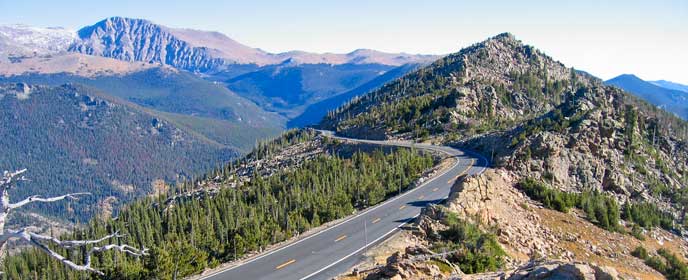
Effective scenic travel follows narrative sequencing rather than arbitrary waypoint selection. Routes often begin with orientation landscapes, transition into increasingly dramatic terrain, and conclude in reflective environments such as lakeshores or high plains.
A classic southwestern route might begin in Las Vegas, move through the Mojave Desert, ascend into Zion’s canyon systems, continue across Bryce Canyon’s hoodoo amphitheaters, and conclude at the Grand Canyon. Each stage builds geological complexity while maintaining directional coherence.
Transportation studies from the Federal Highway Administration Scenic Byways Program emphasize storytelling as a design principle. Roads are curated to reveal environments gradually, preventing visual saturation while sustaining engagement over long distances.
Mobility Without Urban Dependency
One defining characteristic of this tourism model is reduced reliance on major cities. Travelers often fly into metropolitan airports but quickly transition outward, spending most of their journey in non-urban counties.
Rail options such as Amtrak’s long-distance routes complement this pattern by linking cities to landscape corridors, enabling hybrid travel that combines train observation with regional driving loops.
The result is a decentralization of tourism revenue and attention. Landscapes themselves become primary destinations rather than backdrops to urban experiences.
Seasonal Elasticity and Year-Round Viability
National park travel is not confined to a single season. Each period reshapes the same geography into a different visual and ecological experience.
Spring introduces snowmelt-driven waterfalls in Yosemite and wildflower blooms across Texas Hill Country. Summer opens high alpine passes such as those in Glacier. Autumn transforms eastern forests into color-dense canopies, especially along the Blue Ridge corridor. Winter shifts attention to geothermal regions like Yellowstone National Park, where snow travel reveals hydrothermal features with heightened contrast.
This seasonal elasticity allows repeated visitation without redundancy, sustaining long-term tourism cycles.
Photography, Mapping Technology, and Digital Influence
The expansion of mapping platforms and geospatial photography has altered how travelers interact with landscapes. Tools like USGS topographic resources allow visitors to understand terrain before arrival, deepening engagement with elevation, watershed boundaries, and fault lines.
Photography sharing has amplified awareness of lesser-known sites, distributing visitation beyond iconic landmarks. Secondary destinations such as Capitol Reef or North Cascades now attract travelers seeking comparable landscapes with lower density.
Digital navigation also enables complex multi-park itineraries that once required specialized planning knowledge.
Cultural Landscapes Along the Road
Scenic routes intersect Indigenous lands, frontier settlements, and conservation-era infrastructure built by the Civilian Conservation Corps. Recognizing these contexts transforms travel from passive viewing into cultural literacy.
Mesa Verde preserves ancestral Puebloan cliff dwellings through the stewardship documented at Mesa Verde National Park. The Natchez Trace follows a transportation corridor predating European colonization, now maintained as the Natchez Trace Parkway.
Understanding these spaces requires acknowledging that landscapes are both natural and inhabited, shaped by centuries of human adaptation.
Sustainability and the Future of Open-Road Tourism
Climate variability, wildfire patterns, and water scarcity are redefining how parks manage access. Agencies increasingly integrate predictive modeling to anticipate visitor distribution and environmental stress.
Programs highlighted by the National Park Foundation support habitat restoration, trail reinforcement, and education initiatives designed to maintain ecological resilience while accommodating public interest.
Electric vehicle adoption is also reshaping road-trip logistics. Charging networks now appear along major scenic corridors, enabling lower-emission travel without altering route flexibility.
Psychological Dimensions of Landscape Travel
Extended driving through protected environments produces measurable cognitive effects associated with attention restoration. Environmental psychology research identifies natural complexity, low artificial noise, and expansive views as factors that reduce mental fatigue.
Scenic road trips provide these conditions continuously rather than episodically. The sustained exposure differentiates them from short-duration recreational visits, embedding recovery into the structure of the journey itself.
Why This Model Persists
National park-centered travel aligns with multiple contemporary priorities simultaneously: environmental awareness, historical curiosity, personal autonomy, and geographic scale. It leverages an infrastructure network already embedded within protected land systems, allowing expansion without requiring entirely new development.
The enduring appeal lies in synthesis. Scenic roads connect ecological preservation, engineering design, and cultural storytelling into a single movement-based experience. The traveler does not simply arrive at a destination but participates in a continuum where transit and place are inseparable.
National Parks and Scenic Road Trips USA
The phrase encapsulates a tourism model defined not by isolated attractions but by integrated landscapes linked through intentional mobility. It represents a uniquely American convergence of conservation policy, transportation design, and geographic magnitude, forming a travel system where the journey itself functions as the primary site of discovery.
About the Author